

 Everyone


Did you know you couldn’t even get diagnosed with both autism and attention deficit/hyperactivity disorder (ADHD) until 2013 when the DSM-5-TR (Diagnostic and Statistical Manual of Mental Disorders, 5th Edition: DSM-5) was updated to allow for a dual diagnosis. Prior to this, one would be diagnosed with the most prominent condition.
All that is to say, having a dual diagnosis of autism and ADHD (or AuDHD) is a relatively new phenomenon, but one I am intimately familiar with as my three children, myself, and my husband all have both diagnoses. This makes our interactions varied and our brains don’t always complement one another.
Living with an AuDHD brain and with others with an AuDHD brain comes with its own unique challenges.
Let’s look at some of the differences between autism and ADHD and the unique makeup of an AuDHD brain.
The Twelve Executive Skills
But executive functioning is the biggest overlap of traits. Often people think only children struggle with these skills, but I know I still have a tough time with many of these. (The terms I’m using for the executive functioning skills are taken from Embrace Autism, so other sources may refer to them differently.)
- Response inhibition
This is when you may act before thinking. This function is like saying “ready, fire, aim” instead of “ready, aim, fire.” If you struggle in this executive function, you may have poor self-control. Here is where you also would be able to weigh pros and cons in a given situation.With ADHD, this may look like poor impulse control, difficulty waiting, or constant fidgeting or talking. In autism, it’s similar, but here it may look more like difficulties with interference control. They may have trouble inhibiting previously learned or “prepotent” responses than suppressing distractions (Schmitt et al., 2017).
- Working memory
A working memory is similar to your short-term memory, but it’s not the same. It differs from short-term memory because you can manipulate your working memory. Your working memory holds the needed information temporarily.
Difficulty here as an autist may look like challenges around verbal tasks, especially. This is where visual aids may be especially helpful. With ADHD, you may notice struggles in focus and task completion are affected by poor working memory.
- Emotion regulation
Emotion regulation helps you manage your emotions as you navigate your daily life. Without it, you may react inappropriately to certain situations. For example, you may have “big emotions” about something that doesn’t require them. When working with my children’s occupational therapist, he would help them see if the situation was really a 5 (the worst thing ever) or a 1 (not a big deal) and react to reflect the actual situation. Struggles here can also lead to a fight/flight/freeze/fawn response, which can lead to difficulty accomplishing tasks.
In ADHD, struggles here look like difficulty managing emotions, mood swings, intense emotions, and rejection sensitive dysphoria (RSD). In autism, it may look more like difficulty understanding, labelling, and managing feelings. Visual scales, similar to what I mentioned above, is often helpful.
- Sustained attention
Keeping focus when faced with distractions is a challenge here. This also reflects challenges in staying on task. Even when you’re interested in the topic, you may still find your mind wandering.
With ADHD, you may find yourself re-reading the same passage in a book, whereas with autism, you may find your attention can be sustained longer at times. Being AuDHD, I go from one extreme to the other even in a short time span.
- Task initiation
Task initiation is essentially starting something on time. If, instead, you delay starting tasks, this may turn into procrastination. Having ADHD, I often have grand ideas for starting any number of tasks, but rarely begin. The research of these interests is where I spend most of my time rather than starting. If you struggle here, you may need someone to help you get started.
With ADHD, oftentimes, if you find the required task boring or ambiguous, you’re more likely to have difficulty initiating. Autists may have a lack of motivation to begin or struggle to know where to start. I know I relate to all those struggles.
- Planning/prioritizing
This involves creating realistic plans for things that need to get done. Both autists and people with ADHD may struggle similarly here. Organizing your day and making sure everything is completable can be a challenge. You may also keep an untidy work or living space (cleaning is not my strength). This all can be especially difficult to manage when low on spoons. Then I find even thinking about planning can be overwhelming, causing me to procrastinate and not plan.
Autists may find having visual schedules and breaking down tasks helpful. Those with ADHD may also benefit from timers or alarms to stay on track and focusing on one thing at a time to avoid overwhelm. The Eisenhower Matrix may be especially useful here.
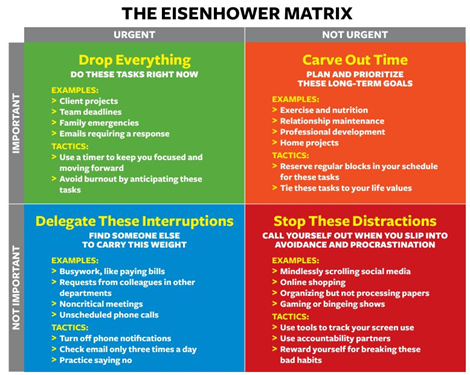
Credit to Additude Magazine
- Organizing
This skill allows us to maintain use of logical systems and routines. Part of this skill is being able to tell a story with a beginning, middle, and end, but also knowing how and where to best put away laundry, for example. Keeping a tidy desk or backpack would fall here, too.
As someone with AuDHD, I love organized spaces but get overwhelmed and confused when I need to organize things on my own. I notice this in my children, too. If we give them a guide, they can follow it but don’t instinctively know how to organize most systems (yet). With ADHD, designating clear zones for specific items can make organizing simpler. For autists, colour-coding, using checklists, and using visual aids may help.
- Time management
This skill is all about knowing how much time is realistically needed for a task and the ability to use time effectively. I see this in my AuDHD children often when they think a task may take hours when in reality it may be 20 minutes. I always like to be early to events or appointments but can never really properly gauge how much time I really need to get somewhere, even if I’ve been there before.
This is where using an agenda or calendar can be useful so you can visually see where your time is literally going. Autists may find this skill challenging because of the abstract concept of time, and those with ADHD may struggle with “time blindness” or the use of their internal clock, forcing reliance on external resources.
- Persistence
Maintaining focus to achieve a goal when faced with distractions can be a challenge if this is an area of difficulty. The ability to keep trying things that you may not excel at right away falls under this skill, too. Being motivated and resilient in the face of adversity can be challenging for us with AuDHD. It can be exhausting to keep trying something only to fail consistently. It’s important we keep pushing through the challenges we face so we can get to the other side and feel that success.
With autists, this can also refer to perseveration (repetitive thoughts/actions) or a positive growth mindset (determination and continued effort). Autists may end up feeling “stuck” on a topic, task, or thought. However, it’s also important to know when “enough is enough” and it’s okay to stop trying. Those with ADHD may find re-engaging in a task challenging and have difficulty connecting present actions to future outcomes.
- Behavioural/cognitive flexibility
For my AuDHD children, this was a big area of difficulty. Even for myself! Managing when things change is really challenging. I would spend days mentally preparing for an upcoming event or appointment or even a meal, and when it changes last minute, I would meltdown. This is a time when I may have situational mutism because I simply could not cope with the change.
Being autistic, this skill is challenging because I prefer and thrive on routine. So, adding something new only to have it change is distressing. This is a skill especially associated with autism as many believe autists need routine and structure to function. Changing tasks as an autist and perspective-taking may be especially challenging for autists. With ADHD, this may come out in difficulties problem-solving or switching tasks.
- Metacognition
This is about thinking about thinking. It’s being able to reflect on own past actions and thoughts. This ability also helps with problem solving and learning because being able to reflect on past actions helps us learn from our mistakes (and triumphs). This skill helps us plan tasks and self-assessment.
It’s something we often use without noticing it, or we may need to force ourselves to be aware of our thoughts as someone with AuDHD. My autistic brain is almost hyperaware of my thinking, whereas my ADHD side is more aloof and less aware. It’s a contradiction and can make thinking and reflecting even more challenging at times. It’s important to note that no matter the person’s neurotype, their metacognition will vary due to individual differences.
- Stress tolerance
This is the ability to cope when things get stressful or to deal with new demands. This may also be referred to as resilience sometimes. It helps us deal when things get difficult and helps us maintain composure in stressful situations. As an AuDHD person, my stress tolerance is not where it maybe should be, and I often end up melting down or shutting down when things get overwhelming.
Because those with ADHD struggle with emotional self-regulation, their stress tolerance may be lowered. They may end up feeling overwhelmed and their emotions may become more intense. They may also be more sensitive to new threats due to negative past experiences, such as making mistakes.
Autists, however, have a lower stress tolerance due to a more sensitive nervous system. A good way to gauge one’s stress tolerance is with Dr. Dan Siegel’s “window of tolerance.” Aside from the nervous system sensitivity, autists may also have a lower stress tolerance due to sensory overload, miscommunication, or changes in routine.
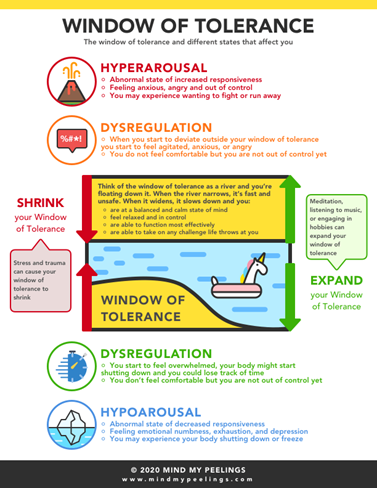
Credit to Mind My Peelings
You may notice that many of these executive functions work together. Your struggles in the organization skills may affect your planning/prioritizing, task initiation, and time management skills. So, if you struggle in one area, you may struggle in others. The twelve executive functions work together to ideally help your own brain allow you to function optimally. As an AuDHD person, though, these skills may struggle with this and that’s where you have to help them work together.
There is a lot of overlap between autism and ADHD, so how can you know which one you have, or if you have both?
Certain executive skills may be more challenging to the ADHD brain, and others more challenging for the autistic mind, and within each individual, there is even more discrepancy.
For example, autistics tend to struggle the most with behavioural flexibility, whereas ADHD brains struggle mostly with task initiation and planning/prioritizing (Embrace Autism, Executive challenges in autism & ADHD, 2024). As an AuDHD person myself, I can vouch for the truth behind both these statements. Because I struggle with planning/prioritizing, I often freeze and do not start anything, fearing failure. If I don’t start something, I can’t fail at it, right? Or I may start a task and struggle to finish it.
Behavioural or cognitive flexibility is a challenge for my whole family. When things change in our plans, pivoting is a struggle. When an appointment is changed or cancelled at the last minute, my anxiety heightens. To cope with this, I’ve learned to try not to be too attached to my plans. I try to think about how this change really affects me; what is the worst thing that can happen because of this change? This helps me see it from a more rational perspective rather than my heightened anxious state.
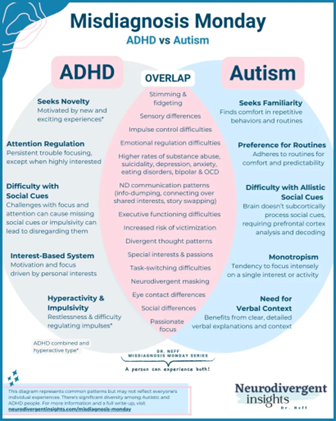
Where both autists and ADHDers struggle can be seen in interoception, social differences, time perception, sensory challenges, stimming, special interests, emotional regulation, nervous system sensitivity, and Rejection-Sensitive Dysphoria (RSD). If there is so much overlap, how do we know which neurotype we have?
Many of the clues that help differentiate the two neurotypes lie in the underlying reasons behind the trait. For example, when examining social differences, if individuals frequently talk excessively or interrupt others, it may be indicative of ADHD. But if they struggle with back-and-forth conversation and speak in monotone, it may be autism (Neff, Dr. Megan Anna. ADHD or Autism (Or Both)?: Misdiagnosis Series Book 5.).
Apparently, it’s also common for those assigned female at birth (AFAB) to get diagnosed for ADHD, but not autism. This is when it’s so crucial for assessors and individuals to understand the differences in the presentation of autism and ADHD in AFAB individuals. According to Dr. Neff, if the assessor isn’t even looking for autism in a girl, for example, it’s likely to be missed and for her to be “diagnosed with ADHD, mood disorders, and personality disorders, while their underlying neurotype remains missed” (p. 64).
Personally, this was my life. I went until I was 36 thinking I was “just” anxious or depressed, until I was diagnosed with ADHD, and then my whole life made more sense. The pieces all really clicked into place once I learned I’m autistic later that same year. My whole life I was misunderstood and thought my brain worked one way when really my neurotype was what was different. Discovering this was liberating and gave me my identity back.
Regardless of sex or gender, differentiating between ADHD and autism is tricky and should be more closely understood by assessors and clinicians. According to Waldren et al. (2024) one way to detect if it’s ADHD or autism can also be seen in whether or not the person exhibits hyperactivity traits since those traits “were least likely to be linked with Autism.” They used their findings to reiterate the importance of assessors understanding the unique differences in autism and ADHD.
Some helpful links to better understand this are here:
- ADHD and Autism: How ADHD and Autism are Related
- Is it ADHD or Autism? (Or Both)
- ADHD and Autism
- Embrace Autism’s page of AuDHD Resources
How is an AuDHD brain different from an autism or ADHD only brain?

From Anne Robertson
Having both autism and ADHD is like having two little gremlins in your mind that each want to do different things or thrive in different environments. One gremlin wants change change change and the other one shouts routine routine routine. Then you – the main gremlin – want both. At the same time, somehow. Knowing this is essentially impossible because they are diametrically opposed things causes dissonance, and this can lead to functional freeze, or ADHD paralysis, or an autistic shutdown. Often these two competing voices cause overwhelm, and when this happens, I just need a break to shut my brain off, if possible.
Being able to take a break like that can be beneficial to an AuDHD brain and also needed to keep functioning. This isn’t a sign of weakness, but rather a sign of understanding one’s neurotype and needs.
The biggest thing with an autistic and ADHD brain is that both want different things. So, like the above gremlins, you may want a routine, but can’t keep it (that’s definitely me). You may also hyperfocus often, then also be forgetful, and seek but also avoid sensory input.
Your behaviours and needs and wants may change from day to day and also during one day. In the morning you may feel like you need more of a structure, then as the day plays out you feel more free and crave chaos. One day you’re the life of the party and the next you’re a wallflower.
Not only is this confusing to the AuDHD person but to those around them. The AuDHD person isn’t trying to be difficult or different all the time; they’re just trying to survive and be themselves in a world that they don’t understand and that is still trying to understand them.
It has also been noted that AuDHD isn’t simply autism + ADHD; it’s its own unique neurotype, making this all that much more complicated because AuDHD isn’t technically its own diagnosis. Though you may have both diagnoses, technically, how they manifest in you may look different. It’s not as if one day you’re autistic and the next your ADHD shows instead. Every day the traits linked to both diagnoses fight for space and you have to try to accommodate both needs while staying a functioning human being.
Here are some great examples on what an AuDHD presentation may look like, from Autistic Girls Network:
- The individual may regularly come up with new routines to try to stick to.
- They may come up with new ways of doing the same thing or follow a particular process when trying something new. They try to satisfy their craving for new while managing their anxiety around change.
- They may impulsively choose change, then experience anxiety due to the change.
- They may regularly seek out new things, but only with familiar people and want to complete things in a particular way or following a familiar process.
- They may regularly burn out from being too busy and overwhelmed socially, but struggle to slow down to recharge.
- Their environment might become messy and chaotic easily, leading to overwhelm and difficulty functioning.
- They may be hyper-organised to compensate for their disorganised brain.
- They may feel anxious every day about running late or not being early.
- They may have an exceptional long-term memory but a poor working/short-term memory.
- Their intense/special interests may regularly change theme or topic.
Life as an AuDHDer is complex and exciting, but also exhausting and chaotic. Despite the challenges it may give my family and me, I wouldn’t change my neurotype for anything because it makes me, me.
Helpful Resources (some may cost money):
Fabulous (app)
Finch (app)
FocusBear (app)
Focused Space (body doubling) (app)
Forest (app)
Google Keep – Notes and Lists (app)
Habit List (app)
TiimoApp (app)
Todoist (app)
Embrace Autism (website)
Neurodivergent Insights (website)
AuDHD: Blooming Differently (book)
Explaining AuDHD: A Guide to Autism and ADHD: A Guide to Autism and ADHD Co-concurrence (book)
The Neurodivergent Friendly Workbook of DBT Skills (book)
Welcome to AuDHD: How to Survive (and Thrive) as an Adult with Autism and ADHD (book)
Irvine, B., Elise, F., Brinkert, J., Poole, D., Farran, E. K., Milne, E., Scerif, G., Crane, L., & Remington, A. (2024). ‘A storm of post-it notes’: Experiences of perceptual capacity in autism and ADHD. Neurodiversity, 2. https://doi.org/10.1177/27546330241229004 (article)
Schmitt, L. M., White, S. P., Cook, E. H., Sweeney, J. A., & Mosconi, M. W. (2017). Cognitive mechanisms of inhibitory control deficits in autism spectrum disorder. Journal of Child Psychology and Psychiatry, 59(5), 586–595. https://doi.org/10.1111/jcpp.12837 (article)
Waldren, L. H., Leung, F. Y., Hargitai, L. D., Burgoyne, A. P., Liceralde, V. R. T., Livingston, L. A., & Shah, P. (2024). Unpacking the overlap between Autism and ADHD in adults: A multi-method approach. Cortex, 173, 120–137. https://doi.org/10.1016/j.cortex.2023.12.016 (article)


