

 Autistic Adults and Allies


Clashing with your autistic roommate as a non-autistic person?
It happens, but getting frustrated and giving up will not benefit anyone. By starting with compassion and the will to support, you can start building a more trusting and mutually beneficial relationship. At the end of the day, that’ll make living together much more pleasant.
Lead with kindness
Approaching your roommate honestly and kindly is step one, and you can’t skip it if you want to move forward. If you’re hostile, resentful, or harbouring any ableism you aren’t willing to confront and address, it’s unlikely you’ll be able to make any proper progress.
Once you’ve reflected and are in an appropriate state of mind to listen, it’s time to start learning, which you’re doing by reading this article. That means you’re well on your way and ready to start making plans!
Learn about autism and autistic adulthood
Learning about autism will help you understand us better. It also relieves us of the burden of responsibility to educate you, which can be exhausting and create an uncomfortable power dynamic.
Remember, autism is a lifelong condition. It doesn’t disappear when a child grows into a teen, a teen grows into an adult, or an adult grows into a senior. What’s helpful for one person may be harmful for another. That means it’s important to study the differences between experiences at each life stage so we know the unique struggles and wins. From there, we can determine which solutions might be helpful and implement them.
Individualized care plans are important to autistic kids, adults, and seniors. Since every autistic adult is so different, we can often benefit from unique and custom-made approaches to improving every area of our lives. That includes establishing a stronger bond with our roommates and becoming more skilled cohabitators.
Understand the double empathy problem
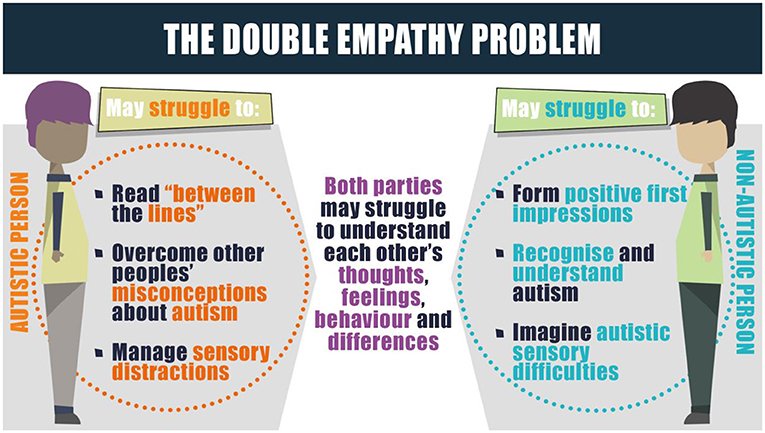
The double empathy problem is a relatively new concept that explains miscommunication between autistic and non-autistic people.
As autistic folks, we often feel like allistic people are “speaking a different language” than us. Meaning is often lost and misconstrued, leaving both parties frustrated and confused.
The double empathy problem confirms this is a mutual experience. It’s not just the autistic person who miscommunicates. Communication differences between the two individuals, including the allistic person, cause misunderstandings.
The double empathy problem encourages us to humble ourselves and focus on the nuance of everybody’s communication styles, autistic or not. To better comprehend each other, we must meet in the middle and attempt mutual understanding.
This reframing is important because it takes the onus off autistic people to “just act normal” and places the responsibility squarely on both parties’ shoulders.
Autistic folks don’t decide to be autistic and oftentimes are incapable of successfully masking (or playing the part of) as an allistic person. Similarly, allistic people can’t magically understand how autistic people speak and think. Once both people face this, they can take responsibility for compromising during communication. This is done by making concerted efforts to meet the other person where they’re at; if both of you try to accommodate each other, you’re much more likely to have successful and enjoyable interactions.
Find common interests and engage in them together
Regardless of personality differences, you share a space, and bonding can make communication and cohabitation easier. Ask your roommate about their favourite hobbies, at-home activities, and places to visit so you can plan to engage in them together. Similarly, you can share your favourite things to do, but remember they may not be accessible to your roommate, so you may need to adapt and accommodate as necessary.
Cooking or eating together can be an easy first activity if you have favourite foods in common. If you don’t, consider doing your favourite solo activities together. This is called body doubling; sometimes, it’s more fun for us than talking or doing a collaborative activity.
Invite us to your plans
Invitations often need to be explicit for us. For example, saying, “I’m going out to lunch later,” doesn’t tell us you’d like us to come too. Instead, ask directly, saying something along the lines of, “Do you want to come to lunch with me?” Include the details of the plans, like when, where, and who else might be coming so we can feel more prepared for the plans.
If you’re always hanging out with your non-autistic roommates without inviting the autistic or neurodivergent members of the household, consider how that makes them feel. Nobody likes being the odd one out, so be kind and invite everybody when you make plans. Even if they say no, it’s the thought that counts.
If your plans aren’t accessible to your autistic roommate, ask them what kind of outing or activity would work for them. Then, follow through and make it happen.
Many autistic adults struggle with communicating, especially with non-autistic folks, so they’ll probably appreciate if you take the initiative to hang out with them. That way, they’ll know you’re interested and will be more likely to reciprocate the effort. We reserve the right to say no, just like anyone else!

Set and respect house rules
An autistic roommate may be frustrated when rules are disregarded, even if you think the reason for doing so is understandable and obvious.
Many of us are very literal and interpret things at face value. House rules are set for a reason, and if anyone living there can’t abide them, they should communicate that to everyone else in the group. That includes us! We also need to communicate what’s in and outside of our capacity. That way, everyone can agree to commitments that are doable for them, barring unusual circumstances.
Creating a standard chore schedule, organizing the space, and more can create structure and reliability that many autistic people find helpful at home. Hold each other accountable for respecting these rules. If that’s unachievable, change them, and always go back to leading with kindness if the atmosphere gets tense. Some chores may be difficult or impossible for us due to cognitive or motor reasons or symptoms from co-occurring conditions, so make sure your requests and delegations are reasonable.
Make communal spaces sensory-friendly
You’ll want to consider how the communal space is set up to affect the five senses: Sight, sound, taste, touch, and smell. Many of us are sensitive to that kind of input and won’t be able to enjoy ourselves unless the environment is sensory-friendly.
Members of our group for autistic adults, Getting Together on the Spectrum, told us about their housing preferences in a recent survey. Their responses helped us confirm what’s helpful for several community members. Here are some of those tips:
Start with the lights. They said it’s important to have dimmable lighting options, lamps and natural light instead of overhead lighting, and the ability to retreat to a dark space if needed.
The other visual element is cleanliness. Tidy the space and reduce any unnecessary clutter, which can be distracting during conversation.
Then, notice the smells. A scent-free environment is best; try to reduce any strong-smelling odours, whether they’re nice or not.
If you can close windows and keep things quiet inside, do so. Having earplugs and noise-cancelling headphones can be helpful during inevitable loud times.
You won’t need to worry about taste too much unless you cook together or for one another. In that case, talk about dietary needs, restrictions, and preferences before you start so everyone can dig in together.
In closing
These tips and more can help you lighten and liven up your relationship with your autistic roommate, even if you can’t understand their experiences firsthand.
Hopefully, they’ll appreciate the effort you’re putting in and reciprocate by doing the same!


